
The Sisters: A Novel
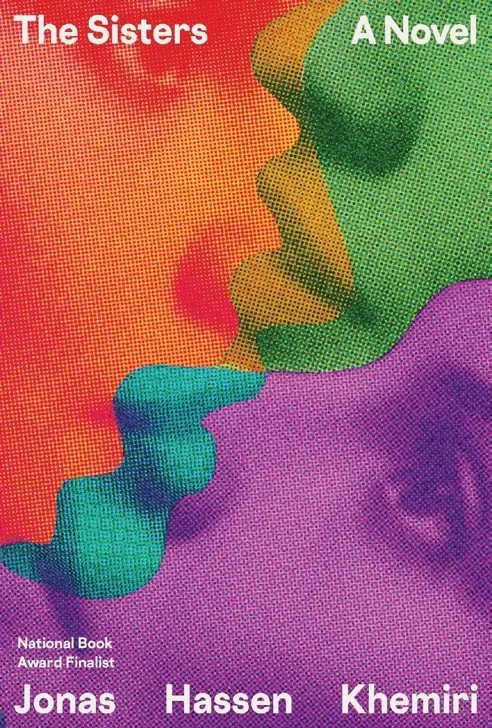
The Sisters
A Novel
by Jonas Hassen Khemiri
Farrar, Straus & Giroux, 2025; 638 pages; $42.00
Reviewed by Jessica Poon
As a person who has almost been successfully kowtowed into the charms of valuing concision above all else — I said almost — I always pay attention when I encounter an author who writes as though the universe were raptly salivating for their next dependent clause. And so it was, which is, incidentally, how Khemiri begins many of his sentences, that I immediately observed Jonas Hassen Khemiri’s love affair with commas, as well as his fondness for tacking on an and. Fortunately, Khemiri’s luxuriously lengthy sentences are far from bloviated. Rather, they replicate an overwhelmed, anxious stream of consciousness that is always anticipating, catastrophizing, projecting, and pain-fully self-aware.
At first glance, the Mikolka sisters have little in common. Their mother is chaotic and overbearing, a Tunisian carpet seller who believes their family is cursed. Ina, the oldest sister, is exceptionally tall, rigorous, and “the only person in the world who could even think of making pooping efficient.” used to being outshone by her comparatively laid-back, outgoing younger sisters, she can hardly believe her luck when she falls in love with Hector, who shares her taste in books and starts a publishing company. Evelyn, the middle sister, is a charismatic storyteller who works in a clothing store a decade longer than planned. Though she can charm anyone, she is lonely and unfulfilled until she enrols in a competitive drama school, which circuitously leads her to New York. Anastasia, the youngest, is noncommittal about art school and, improbably becomes an advertising executive whose most lauded ideas come from her contrarian nature. But she remains haunted by a former lover in Tunisia. And then there’s Jonas, Khemiri’s namesake character, who, like Khemiri, is a writer.
Set predominantly in Stockholm but with excursions to Tunisia, New York, and Paris, each subsequent section occupies a shorter span of time than the previous. The first section, set in 2000, is over the course of a year and the last section, set in 2035, spans a minute. Chapters alternate from the sisters’ point of view, written in third person, and then to Jonas, who narrates in first person. There’s an in-built frustration with this structure — once you’re emotionally invested in a certain cast of characters, the scene changes.
Jonas’s narration is most poignant when he talks about his father, whose traditional masculinity is at odds with Jonas’s gender-ambivalent long hair as an eleven-year-old. Jonas fumes and resolves never to speak to his father, to take revenge the only way he can — by telling his mother. But that same day, Jonas’s father helps a woman whose newsstand has been robbed. Jonas decides instead to rhapsodize to his mother about his father’s heroism: “I enjoyed turning my father into a story, somehow it gave me power over him, it seemed like the only power I had.” And so, likewise, Jonas’s fixation with the Mikolka sisters — whereas, he is barely a footnote to them — gives him agency, the power of narrativization, and artistic clout. But none of this is a sufficient prophylactic for his anxiety and depression.
Most of the characters are hewn in by their roles in relation and as perceived by others, all the while contending with impostor syndrome and inferiority. Jonas writes: “I was slowly becoming a person I had never been before, and I didn’t understand where this person had been all my life.”
Of all the sisters, Ina is written with the most care. More attention could have been given to Evelyn’s relationship with an increasingly controlling partner, whereas Anastasia’s flightiness can seem more like a stereotype of a youngest child, rather than a nuanced character. When it comes to the sisters’ relationships with each other, though, their dynamic is combustible and life-like. Their constant comparisons, suppressed envy, and subtext-wringing are uncomfortably true. Are the Mikolka sisters really cursed, or are they just alive?
Emotive, lengthy, yet also compulsively read-able, fans of Elena Ferrante, Karl Ove Knausgård, and Dostoyevsky, will find much to appreciate in The Sisters.