
Mary Pratt: A Love Affair with Vision
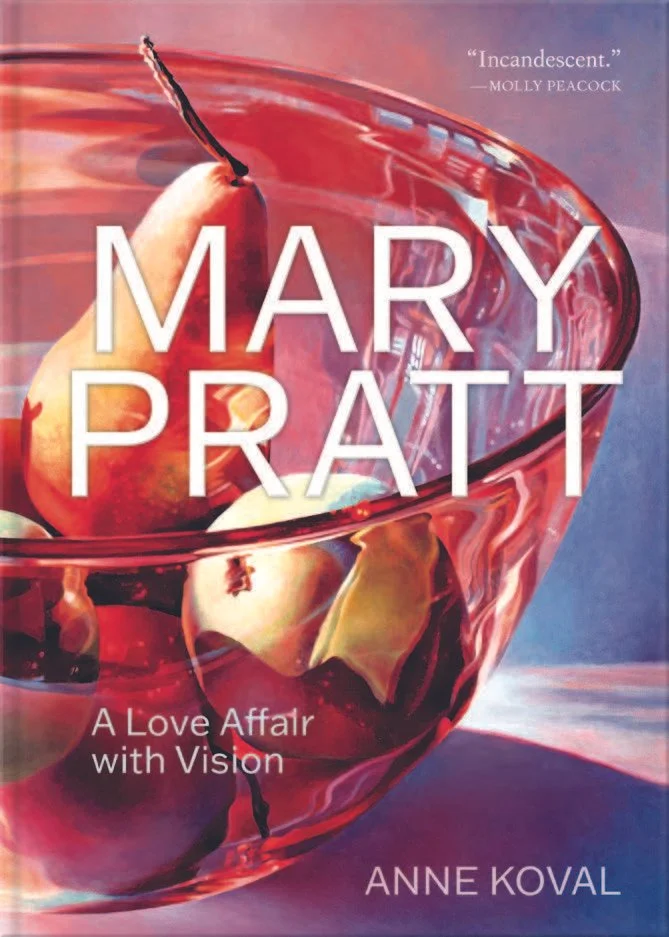
Mary Pratt: A Love Affair with Vision
By Anne Koval
Goose Lane Editions, 2023; 320 pages; $45.00
Reviewed by Heidi Greco
To many of us, the name Mary Pratt conjures up colour, often in images of homely domestic goods such as jams or jellies. This biography of Pratt brings us closer to this important Canadian painter’s sensibilities regarding her life’s work — at the easel, in the kitchen, as well as in matters as personal as affairs of the heart.
Author Anne Koval (who’s also written books about the American artist, James McNeill Whistler) has done substantial research towards completion of this book. But beyond the realm of fastidious research, this book offers much more than any Google search would unearth. Koval is able to offer more personal insights than many others could have by the simple fact that she spent time with Mary Pratt and came to know her as a friend. Such a window into knowing this artist provides a vision unsurpassed.
Pratt’s education in Fine Arts at Mount Allison in Sackville sounds totally inspiring. Her instructors included Alex Colville and Lawren P. Harris, son of the Group of Seven’s Lawren S. Harris. Mount Allison is also where she met the artist who would be her husband for much of her life, Christopher Pratt. Koval explores Mary Pratt’s love of colour, a trait evident already when Mary was a child attending Sunday services with “…her family [who] sat in a pew on the left side of the church, close to the stained-glass windows that dominate the space. As the sun shone through the windows, she observed how the colour intensified with light. During those Sunday sermons, rather than contemplate God, Mary contemplated colour.”
This love of colour would come to dominate her work, with a major shift occurring in 1968 when the sight of their unmade bed caused the usually-conscientious about housekeeping Mary to drop her cleaning supplies and grab “…her portable trolley with its paints and brushes...” and start painting the rumpled, unmade bed. She was so taken with exactly how the bed looked, she insisted that she and her husband sleep elsewhere in the house so the vision would not be disturbed while she created the painting, one that would become a signature piece of her work, one that’s called simply The Bed, an image that would show up on “…the cover of Alice Munro’s short story collection, Runaway.”
The effects of Newfoundland light inspired more than her breakthrough painting of the bed; this was where she turned to painting images of the everyday items of domesticity, especially foods, whether bright jams and jellies (which would later appear on a Canadian postage stamp), or baked apples, broken eggshells, piles of fish, or even slaughtered prey — several studies of moose carcasses, partly inspired by works of some of the European masters. Her experiments with using clear wrap or tinfoil with food are realistic enough to tempt one to touch them, yet glow with a light beyond what I’ve ever seen in my kitchen.
Still, her personal life wasn’t just one big painting spree. The Pratts had four children who survived, along with a pair of twins who died — one in utero, the other shortly after being delivered. The sadness filled her and left her weeping “…for hours on the couch in her housecoat. At this time there was little or no support for grieving mothers or their families. Mary, immobilized by grief, was unable to work for the first time in her life.” As things turn out, her marriage with Christoper ends, and even though she marries another man, she keeps the Pratt name.
Filled with many gorgeous colour plates, inserted always in context of the biography, this book is a treasure trove of information and the glorious visions which Mary Pratt was able to share through her amazing art. And truly, at $45, an amazing value.