
Fanny and the Mystery in the Grieving Forest
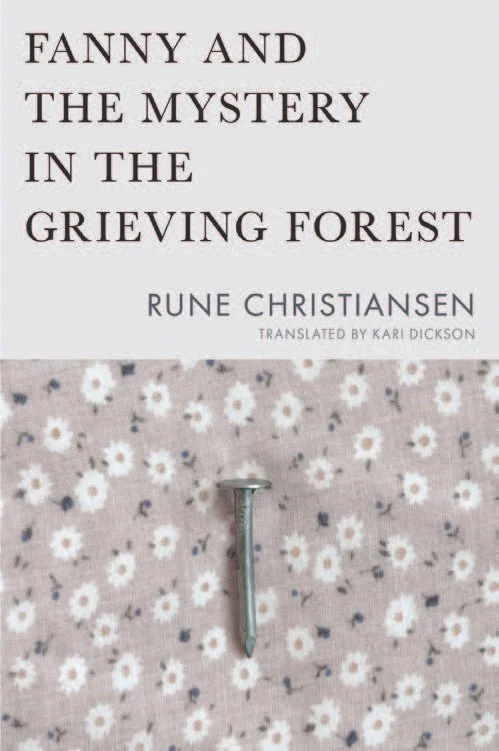
Fanny and the Mystery in the Grieving Forest
by Rune Christiansen
Translated by Kari Dickson
Book*hug Press, 2019; 226 pages; $23
Reviewed by Gerilee McBride
I can’t help but love a book in translation. Words that are correct but not quite right. Historic memory that one can read about but not quite access in the same way as a person born to that place. And most especially the language laid down in such a way that I know it’s trying to say something that’s indefinable in English. They all serve as clues that make me feel like I can climb into the story and inhabit that culture for a short time if only I can find the pattern or see the rhythm. The English language translator, Kari Dickson, has done a pretty perfect job of translating the nuanced story of Fanny and the Mystery in the Grieving Forest from Norweigan author Rune Christiansen. Whereas IKEA has taught me what lingonberries are, Christiansen/Dickson has taught me that ells are units of measurement and dalers are currency. Oh, and that cats are pretty important in Scandinavian folklore.
Allowed to continue living in her home after her parents were killed in a car accident, seventeen-year-old Fanny spends her days moving her body to create space in the house. She goes through the motions of what is necessary to keep her life going while quietly and deeply grieving her parents’ death. We learn about Fanny in fragments of her daily life: waiting for the bus, attending school, having a crush on her classmate Janus; and, in fragments of her dreams: floating up to the sky-light in a bus roof, a wet badger in the kitchen, a small girl in a mirror. But Fanny also loses time — she has bouts of insomnia followed by stretches of time that become lost to exhausted sleep. An entire chapter, “but one of the Calender Windows Was Empty” is followed simply by an ellipses on a blank page. The ellipses standing in for lost time and loss of consciousness. Christiansen, who has previously published twelve collections of poetry, writes with a lyric quality that is reflected in his prose with chapter titles that effortlessly stand in as verses, and the chapters themselves, a scant few pages long, mimicking the structure of stanzas. In between the quotidian, Fanny exists in the dream world and as the chapters progress it becomes more difficult to distinguish between what is happening in reality and what is happening in her sleep consciousness.
Fanny, not one for nostalgia, resolutely takes each day as it comes and yet cannot shake her grief until she meets a friend who gives her the notion that maybe she doesn’t have to be lonely anymore. It’s Fanny’s relationships with the people she encounters that brings her out of her fugue and she is able to see death as a transitory space in the natural world. Christiansen has thoughtfully written a lovely treatise on death and life, and the sad and happy things that occur when grief becomes a living presence. It’s not until the end of the story when Fanny lucid dreams that her dreamscapes begin to make sense and we see where Christiansen has so patiently led the reader. And then it’s easy to start over again from the beginning, “Slowly, slowly. All that effort. Nothing happens on its own.” »