
Flaming June
Fiction by Kimberly Alcock
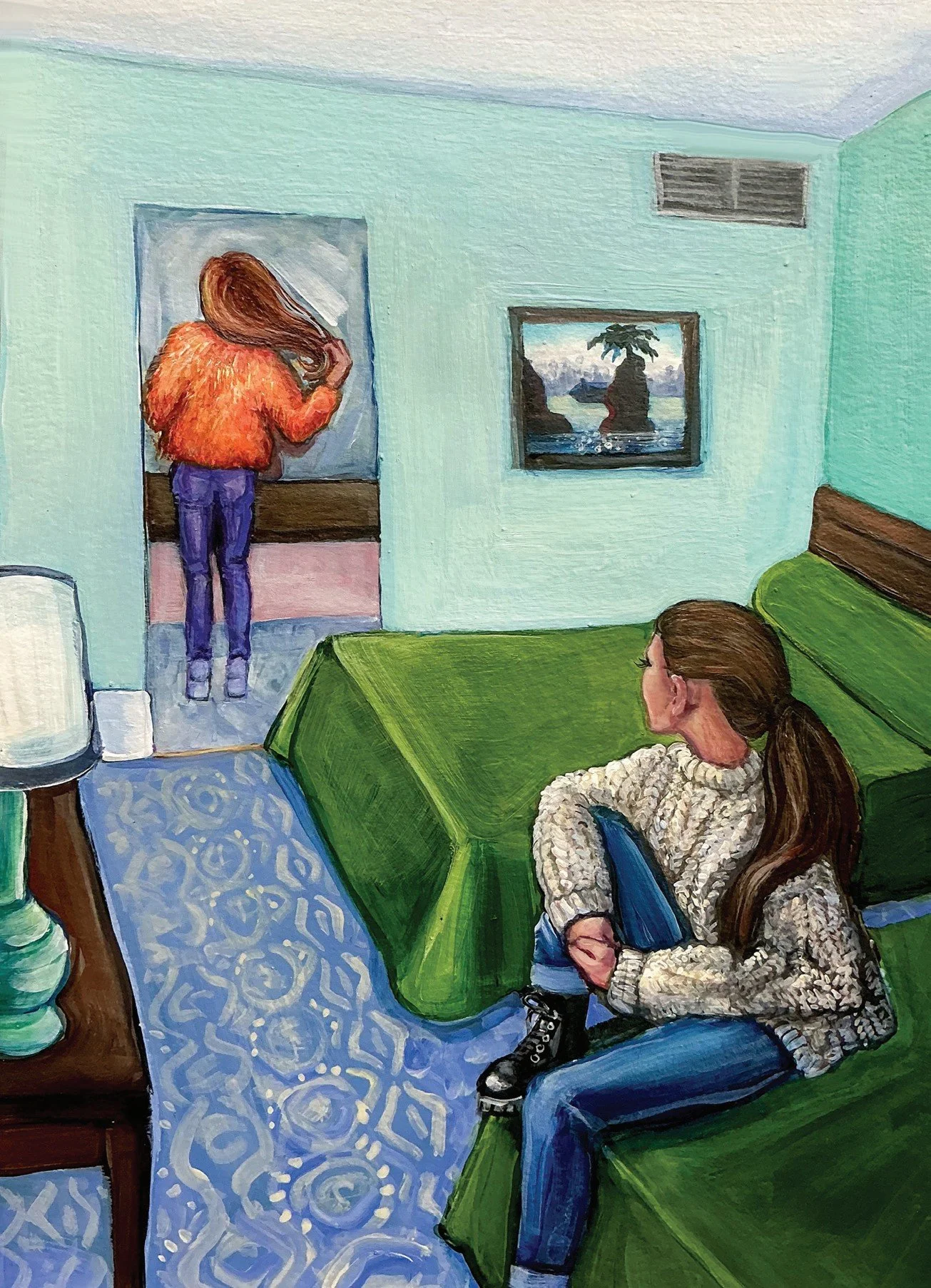
Back straight as a beauty queen’s, Aunt Ava, white platform boots and a shaggy orange coat, has materialized on Carol’s back porch. A mirage. My yearning brought her here.
“How did you find me?” The last letter I sent her came back undelivered.
“I went to see your case worker and spilled coffee on her. When she went to get cleaned up, I looked in your file.” Ava winks and we laugh.
I rummage my army bag for cigarettes and Ava lights up the Export A I offer, the same brand my mom smokes. The burst of flame from Ava’s lighter matches her hair. Flaming June hair, that’s what one of her husbands called it. “Never told him it came from a bottle,” she chortled.
Flaming June. I like this phrase. As I sit beside Ava on the concrete steps that lead to Carol’s porch, I think of other reds. Oriental poppies. Campfire sparks.
I observe the winter sky. Late October, the sun fled the valley and a thin grey dome hovers above. If I were Superman, I would zoom to the stratosphere. I would pierce the winter haze and haul back the sun.
I tell Aunt Ava this. She says, “So that’s what your superpower would be, flying?”
“I could go anywhere.” On my bedroom wall, a map of the world. I trace continents with my fingers, commit shapes to memory.
“Where would you go?”
I think about the coast, my mom. I imagine her walking near Siwash Rock, a lone outcrop in the sea marked by a twisted Douglas fir on top. Carol has a mug with an image of Siwash Rock. When I drink my tea in this cup, I think of my mother. If I think of her in a deliberate way, she’ll know. She’ll know, and she will think of me, too.
Carol comes up the back walk, stops mid-stride. I cough out the smoke I was about to exhale. Cigarette smoke makes Carol sick. I promised her I’d quit, but I can’t seem to hold this promise. My hands need something to hold on to.
But it might be Ava that makes Carol uneasy. I get it. Not everyone can handle my aunt. At the McDonalds drive-through, Ava will break into song. I’m So Lonesome at the top of her lungs. In Vegas, when she was a showgirl, my aunt wore outfits like Cher, studded with feathers, pieces of leather cut to reveal her alabaster thighs. My aunt carries these showgirl photos in her handbag, and she’ll show them to anyone she meets — waitresses in coffee shops, cashiers at the gas station.
Carol rubs the tender pouches beneath her eyes. She did a twelve-hour shift at the hospital so she could spend Christmas Day with me. She lifts her chin. “So, I guess you’ll be staying with Ava for a few days?”
I shiver. I stole this fisherman’s sweater I’m wearing, and maybe that’s why it doesn’t always keep me warm. Deep in my gut there is a patch of ice that freezes or melts on alternate days. Melting, it distills something like caution into my veins. This ice never leaves me — whether it’s melting or cold or silent, it’s there. Right now, it’s quivering cold.
But I’m hungry for Ava.
Every winter, knowing a visit from her is near, I think about Ava’s stories. Her first husband was a jockey in the horse races. Her second, a mathematician at MIT. And she even dated Robert Wagner before he was on Hart to Hart.
If I could, I would date Shawn Cassidy. The guy with the fisherman’s sweater, an exchange student from Holland, looked a bit like Shawn Cassidy. He didn’t want to give me his sweater, so I took it. I thought he would just think he left it behind. It would be the sweater he lost on his trip to Canada. Years from now, I will learn this sweater was the only gift he ever received from the father he barely knew. The sweater will become one more thing in my life I wish to undo.
“Where will you be?” Carol pushes her glasses up the bridge of her nose. I have an eyeglass chain stashed in my room, wrapped for Christmas morning.
“I got us a room at that motel on the highway. What’s it called?”
Carol nods. “I know the one. Just over Christmas, Ava.” There’s a warning there, but I don’t care. Staying at a motel is like being on vacation. I’ll be just like any other girl, hanging with family over the holidays.
The motel smells like bug spray. We open the windows and sprawl on ugly twin beds.
Aunt Ava says, “Tell me what you’ve been up to.”
Ava doesn’t ask me questions in the same way guidance workers or teachers do, like they’re trying to figure out the psychology of my mind. She doesn’t look me up and down, sizing me up like strangers who think they know all about me from how I look on the outside: army boots and Wrangler jeans, hair so long I can almost sit on it. Black kohl around my eyes.
“Any boys?”
I release a piece of black licorice from the bag on the bed, “How about you? Any new husbands?” I chew.
Ava goes to the dresser and releases her hair. It rolls down her back in a single gesture, like a hand that waves once and then is gone. “This is the last one.”
I offer, “There was this one guy.”
She twists around. “Did you love him?”
I don’t know how to answer. Daryl confused me if that’s what love is. At a school dance, he asked me to dance a slow song, and later we snuck behind the bleachers to kiss.
Monday morning, he ignored me. I saw him and he didn’t say hello. My insides burned a line of fire, but I wanted more of those kisses; they erased things inside me. So, I went to his uncle’s garage where he worked fixing cars. For months, we made out in half-finished car shells, metal shapes cocooning us. His kisses made me dizzy. All the photos in my mind, a litany of foster parents, and my mom, too, merged into a far-off horizon. Inside these kisses, no one else existed.
This autumn, I looked up from my locker, and there he was, strolling down the hall with his arm around Kim Cates, a blonde girl who wore her beauty as if she knew the power it held. Daryl sauntered past like he had never known our kisses. I stood immobile; my face as naked as the new girls in the showers at juvie.
“Spark,” my aunt says.
My daydreaming annoys teachers. They shake their heads like they’ve given up on me. Sometimes, I want to give up, too. I want to jump off the City Bridge and dive into the lake, slip down into water deep as forever.
“Spark.” Ava is still at the dresser, and I take up her hair in my hands. She reaches for her brush, a yellow bruise on her hand.
“What did you do?”
“Oh, that’s nothing, hon. Just from an IV. Had some woman troubles.”
Every month, when the blood leaks out of me, I am repulsed. I am terrified blood will seep through my jeans at school, on a bus, walking down a street. The blood, the queasiness that comes with it weakens me.
I lie down on the bed. “Tell me something.” I want a story.
Aunt Ava sits on the edge of the mattress. She strokes my hair, and under her hand, I stay still as a cautious cat.
“How would you like to live with me and be like my natural born daughter?”
Ice water trickles. “All that red tape.” This is what Ava says. She can’t stand all the red tape she has to go through to get to see me.
But Ava only laughs. She puts a blanket on top of me. Then, she leans down, unlaces, and edges off my army boots. She wraps the blanket around my feet, and I go to sleep like that, safe on an ugly bed.
I dream about my mom. On an ocean’s shore, sunlight wavers. I reach to her, but the sun erases her, and I fall on the sand. I rise out of my body and look down at its form on the beach below. I can see right through my skin. I am hollow on the inside — no muscles or blood create the shape that I am, only tunnels of white bone.
I open my eyes to slivers of sunlight on the carpet.
I slide off the bed and to the door in my socking feet, rummaging in my pockets for smokes. I try to dredge up the scent of sea-water, of fir trees, and my mother’s face, but she is a shadow. She is a shape of all I don’t know — a silhouette of swollen rainwater and blue-grey sky.
Ava is gone, her bed unwrinkled. I don’t know where she might be, but then she comes through the door, laden with shopping bags. “I’ve been up all night. I have a plan. We don’t need to get permission for you to come live with me. We just cross the border, that’s all.”
“But...” I know we can’t do this.
She digs through her bags. “Look what I got you.” She pulls out jeans and a soft, black sweater. As I stroke it, my chest tightens. I don’t remember the last time I owned anything new. For years, I’ve worn secondhand from the Salvation Army.
The girls who have things, clothes and jewellery and sneakers, believe they are better for having them. And I believe this. I believe they are worth more, valuable in a way I am not. I don’t know it yet, but I will spend my adult life pulled between wanting, craving beautiful things, and, at the same time, wanting only to be the girl I am right now, combat boots, an old T-shirt, and blue jeans. Just me.
I hold the sweater up to my chest.
Ava beams. “Beautiful. Put it on and I’ll take you to breakfast. And we need your passport to take you across the border.”
“I don’t have a passport.”
Ava pulls more things out of the bags — a cobalt blue scarf and matching wool gloves, packs of socks, a narrow black skirt.
“Aunt Ava, I don’t wear skirts.” I reach for the jeans, the blue scarf.
“That will make your eyes look fierce. Go on,” she motions to the washroom. “I’m going to take you out on the town.” She goes to the bureau, pulls a lipstick from her cosmetic bag, and starts to do her lips.
In the bathroom, I wash my face, swiping away yesterday’s remnants of kohl and mascara with a wet facecloth. The girl in the mirror has never been to juvie. She is a girl whose mother buys her sweaters and fixes her hair. She is like the other girls at school who have new things and wear them without effort, without want or need or desire.
When I come out in the sweater, Ava glows.
“Perfect. Denny’s for breakfast? Pancakes?” She doesn’t wait for an answer. “No, we should go somewhere special. The Capri Hotel. Come on Chickadee,” and she’s out the door.
In the Capri Hotel cafe, Ava talks fast to the waitress and orders a Monte Cristo sandwich for me, and pancakes, juice, and coffee. When the waitress leaves, Ava studies me. “We need to do your hair.” She rummages through her handbag, pulls out a brush and elastic. She comes round the table to me and starts brushing my hair.
I scrunch my shoulders. “Aunt Ava, you can’t...”
“What, brush your hair? Why ever not?” She secures the bulk into a ponytail, and then, thankfully, returns to her own chair.
“It’s just, it’s a restaurant...”
“A pretty fine one at that.” She waves one arm. “Nothing but the best for us, right, Kiddo? Why don’t we get you a haircut today?”
I pull the ponytail over my shoulder. I haven’t had a haircut for years. It’s not the sort of thing Carol thinks of, and I save all my own money to get to the coast.
Ava stands. “If we go to the mall right now, we might be able to get you in. There’s that snazzy place there — what’s it called?”
“We haven’t eaten yet.”
“Oh, food,” she scoffs. “Food, food, food. What I need is coffee.”
The waitress comes up with our order, and my aunt sits back down. She takes a sip of orange juice.
“Not hungry,” she announces. She stands, reaches for her handbag, and pulls out her pack of cigarettes. “I’m gonna go for a walk in the lobby, hon. You eat your sandwich.” She sashays away.
I take a bite. The melted cheese oozes warm.
I look around at the other diners. No one seems to have noticed my aunt.
I relish each bite of that sandwich. Sundays, Carol makes family-type meals: beef and carrot stew, canned pears. We sit at the kitchen table, and I look out the window at the hills that rise and shadow the house. Sometimes, sitting with Carol, a stillness washes over me.
I wish I could feel this stillness now, but the ice inside me is there, cold, again.
Ava comes back, and I’m done eating. The waitress comes up to us. “Is there anything wrong with the food, ma’am?” because the pancakes are still on the table, along with my aunt’s coffee.
Ava smiles brightly. “Not a thing. How was your sandwich, Spark?”
“Great.” I stand.
“See? Great. It was great. I’m not so hungry now. That happens sometimes to women,” my aunt says in a confidential whisper, and the waitress nods, begins to take the plates away.
“Christmas shopping.” She tugs at my pony-tail, “And a snip of the scissors for you.”
My aunt tells me to drive. Beside me, she takes off her boots and socks and puts her feet up on the dashboard. At each light, when the car is steady, she reaches down and swipes a toe with red polish. For Christmas, she explains. She keeps a whole array of nail polish bottles in the glove compartment.
I enjoy driving. I like the feeling that I could just keep going and going, drive into an undefined forever.
At the hair salon, an elfin woman, Helen, runs her fingers through my hair. She lifts its weight, then lets it fall back down. “You’ve got some natural wave, you’re lucky.”
I’m in a trance; the smells of coconut shampoo, the black cape swung around my shoulders are exotic. I think about Ava. I chew on a hangnail.
“Now don’t be nervous. You haven’t had a haircut in years? How many?”
“I don’t know.” No foster mother has ever bothered about my hair, not since Jill, my first foster mother when I was five. “Not since I was little,” I confess. I haven’t thought of Jill in a long time, and the memory startles me.
Helen pats my shoulder. “Let’s get you shampooed.”
The girl behind me rubs the shampoo into my scalp, builds suds, and then rinses. When Jill cut my hair, she placed scotch tape over my bangs to get the line straight, then sliced with her sewing scissors. She smiled. “Perfect.”
I blink. The memory has startled me. I breathe in and push my breath back. Soft moments make me soft.
I am in the cutting chair now, time having passed without my noticing because I’m remembering Jill and thinking about Ava, too, nervous about where she might be, and slices of my hair fall to the ground. Swish.
A security guard approaches the reception desk, and the woman at the desk calls Helen over. Goosebumps ripple up my forearms as Helen comes back to me.
“It’s my aunt, isn’t it?”
“We’re just going to finish here.” She combs out my hair. “I’m just checking the ends.”
My breath is tight. “My aunt was going to pay.” I don’t have enough money on me.
“Don’t worry.” Helen takes up a blow dryer, turns it on and works a brush through a section of my hair. It’s all I can do not to cry at her kindness.
Later, in the hospital, Carol comes up beside me sitting at the nurses’ station.
“They won’t let me see her.”
Carol sits on an empty chair beside me. “It’s just until they assess Ava and get her stable. It’s best if we come back tomorrow.”
“She was going to adopt me.”
Carol puts her arm around my back, her hand resting on my shoulder.
In my mind’s eye, I see my aunt, one summer years ago, showing me how to dance. She’s spinning around on a lawn, her arms held out to keep balance, her Flaming June hair spiralling out behind her, bright as a poppy in the full glory of a high summer day. My aunt goes high, then low. This is the weight she carries.
That night, snow arrives in the valley. Early morning, I peek out my window into the backyard. The bare limbed trees have opened their arms to the softness of the opaque white. Hours later, when light seeps from beneath the filmy kitchen curtains, I warm my feet over the radiator. The snow continues to fall, settling upon the back porch stairs where Ava and I sat and smoked, and in the yard beyond, snow covers the naked tree branches, the old walnut tree, and the thin, dead grasses of autumn. Something inside me falls, too, as softly as snowflakes land, taking visible shape only when each flake is joined by the presence of others. »